

News
Structure–function insights of poly(β-amino ester)s for efficient nucleic acid delivery
18.08.2026
Zihnil A.I. Mazrad, Seema Agarwal
European Polymer Journal, 2026, https://doi.org/10.1016/j.eurpolymj.2026.114893
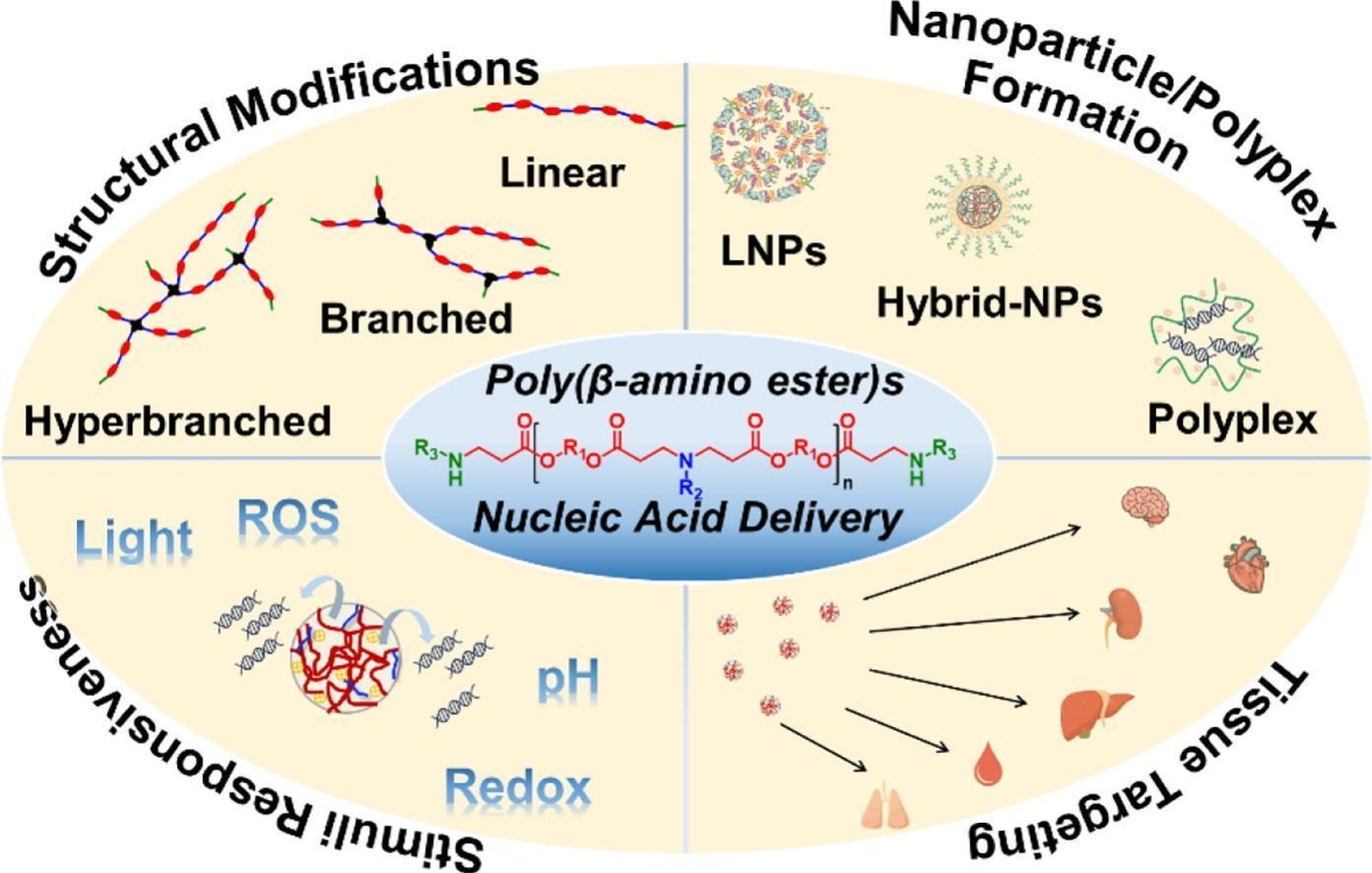

Nucleic-acid therapeutics hold great promise but face delivery barriers such as enzymatic degradation, poor cellular uptake, and rapid clearance. Poly(β-amino esters) (PBAEs) have emerged as a highly versatile and modular platform for non-viral gene delivery, addressing many limitations of conventional cationic polymers such as polyethyleneimine (PEI), including cytotoxicity, poor biodegradability, and lack of stimuli-responsiveness. Their tunable chemical architecture, comprising hydrolyzable ester backbones, protonatable amines, and functionalizable end-groups, enables precise control over nucleic acid condensation, endosomal escape, intracellular trafficking, and cytosolic release. Rational modification of backbone structure, branching, end-groups, and stimuli-responsive motifs has enhanced transfection efficiency, stability, and targeting. This review summarizes recent advances in “smart” PBAEs that enable stimuli-responsive, targeted delivery of nucleic acids. We discuss design strategies (linear → branched → hyperbranched architectures), functionalization including PEGylation, zwitterions, and lipid conjugation, and incorporation of stimuli-responsive motifs such as pH, redox, reactive oxygen species (ROS), and light. Hybrid systems, including in lipid nanoparticles (LNPs) and hydrogel composites, are examined for improved stability, organ selectivity, and therapeutic efficacy. Finally, we outline current challenges, including scalability, long-term safety, and formulation stability, and propose future directions to enhance clinical translation. PBAEs thus offer a highly adaptable platform for next-generation, safe, and precisely controlled gene-based therapeutics.