

News
Influence of reaction parameters on the horseradish peroxidase-catalyzed oxidation of cis-1,4-polyisoprene
29.07.2026
Alina Hering, Chengzhang Xu, Bryan Rojas-Ramos, Andreas Möglich, Andreas Greiner
e-Polymers, 2026, https://doi.org/10.1515/epoly-2026-0013
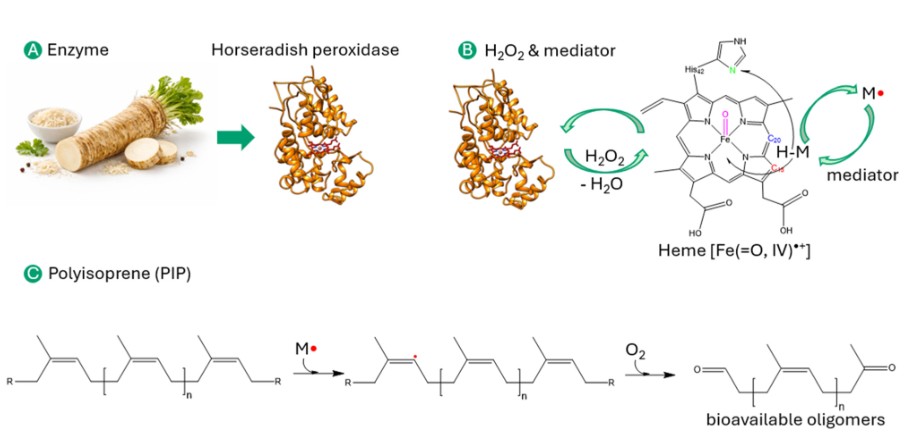

Cis-1,4-polyisoprene is a persistent environmental threat, particularly when present as microplastic debris due to its resistance to natural degradation processes. The oxidative enzyme horseradish peroxidase (HRP) can initiate oxidative chain modification of polyisoprene and thus represents a promising approach for the conversion of elastomeric microplastics into more bioavailable products in technical treatment processes. However, the use of HRP for the degradation of polyisoprene is still not ready for technical applications and requires a better understanding of the reaction conditions that maximize enzymatic activity. Therefore, we systematically investigated the influence of temperature, buffer concentration, pH, and the stoichiometric ratios of HRP, hydrogen peroxide, and mediator on the HRP-catalyzed oxidation of cis-1,4-polyisoprene. Optimal conditions were identified and validated through the enzymatic degradation of polyisoprene latex emulsion as a model system for microplastic particles, with carbonyl-containing oligomers confirmed qualitatively by colorimetric assays. Overall, the results provide experimentally supported guidelines for maximizing HRP activity toward polyisoprene oxidation and establish a technical foundation for further development of enzymatic treatment strategies targeting elastomer-based microplastic contaminants.