

News
Data-Driven Design of Co-Continuous Morphology in PS/PMMA Two-Phase Polymer Blends: A Theoretical, Experimental, and Machine Learning Approach
10.04.2026
Juan Felipe Castro-Landinez, Tasmai Paul, Rodrigo Q. Albuquerque, Holger Schmalz, Andreas Greiner, Holger Ruckdäschel
Polymer Engineering & Science, 2026, https://doi.org/10.1002/pen.70497
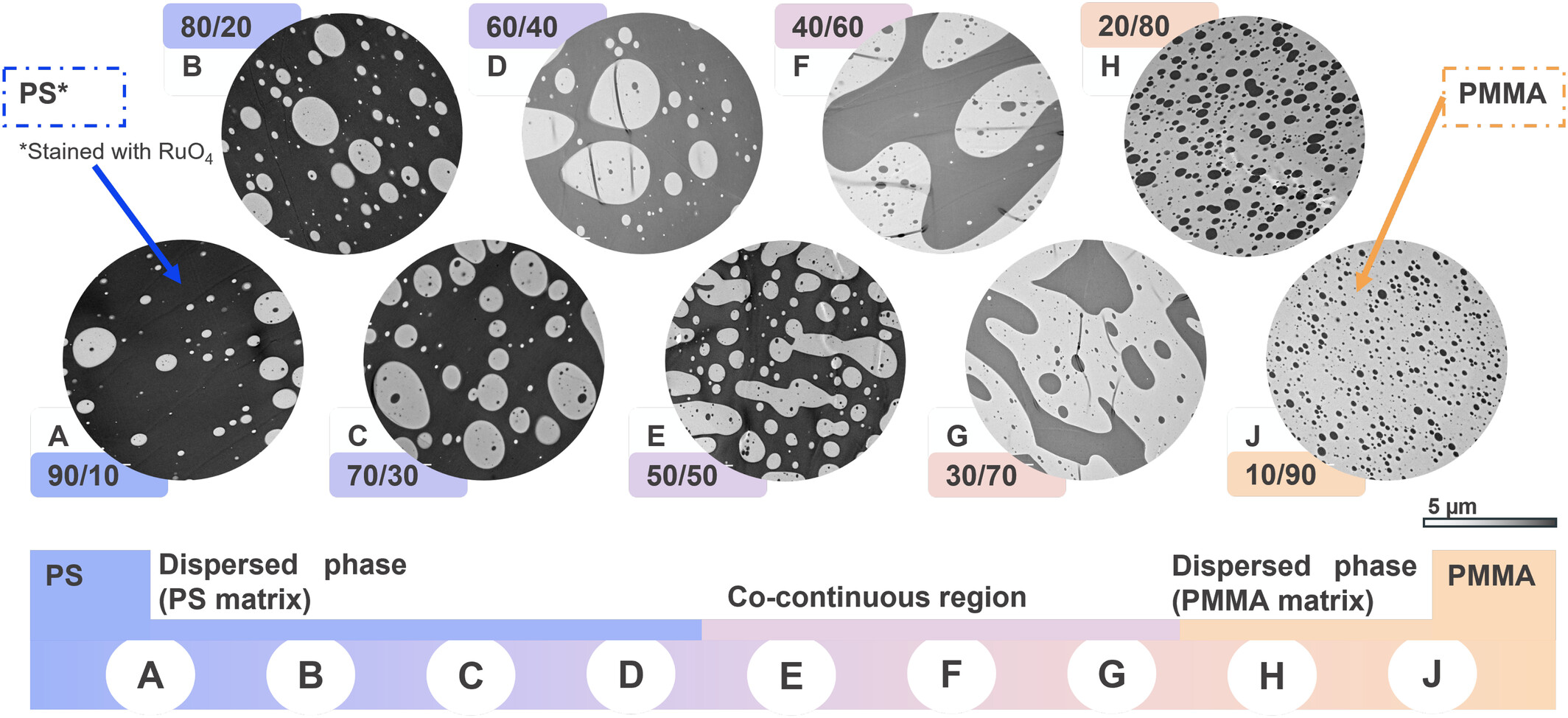

The morphological control of immiscible polymer blends is critical for tailoring material properties, yet predicting phase structures remains challenging. This study combines theoretical modeling, experimental characterization, and machine learning to analyze morphologies in polystyrene/poly(methyl methacrylate) (PS/PMMA) blends. Phase inversion compositions were predicted using Utracki and Yu-Bousmina-Schreiber models at 60–68 wt% PMMA, correlating well with transmission electron microscopy observations. A PS-b-PMMA diblock copolymer compatibilizer effectively stabilized morphologies and broadened the co-continuous region. A co-continuity index (CCI*) quantified morphological characteristics, revealing maximum co-continuity (CCI* = 0.70–0.86) in the 40–60 wt% PMMA range. Bayesian optimization identified optimal processing windows with minimal experiments, while machine learning models, particularly random forest, successfully predicted co-continuity indices. Compositional factors dominated morphology formation over processing conditions. This integrated methodology provides an efficient framework for accelerating polymer blend development with reduced experiments required.