

News
Same but different: The response to petroleum and biodegradable bio-based microplastics deviates between Daphnia magna clones
01.03.2026
Simona Mondellini, Michael Schwarzer, Marvin Kiene, Gabriël Olthof, Dipannita Ghosh, Seema Agarwal, Martin G.J. Löder, Martin Wagner, Christian Laforsch
Ecotoxicology and Environmental Safety, 2026, https://doi.org/10.1016/j.ecoenv.2026.119934
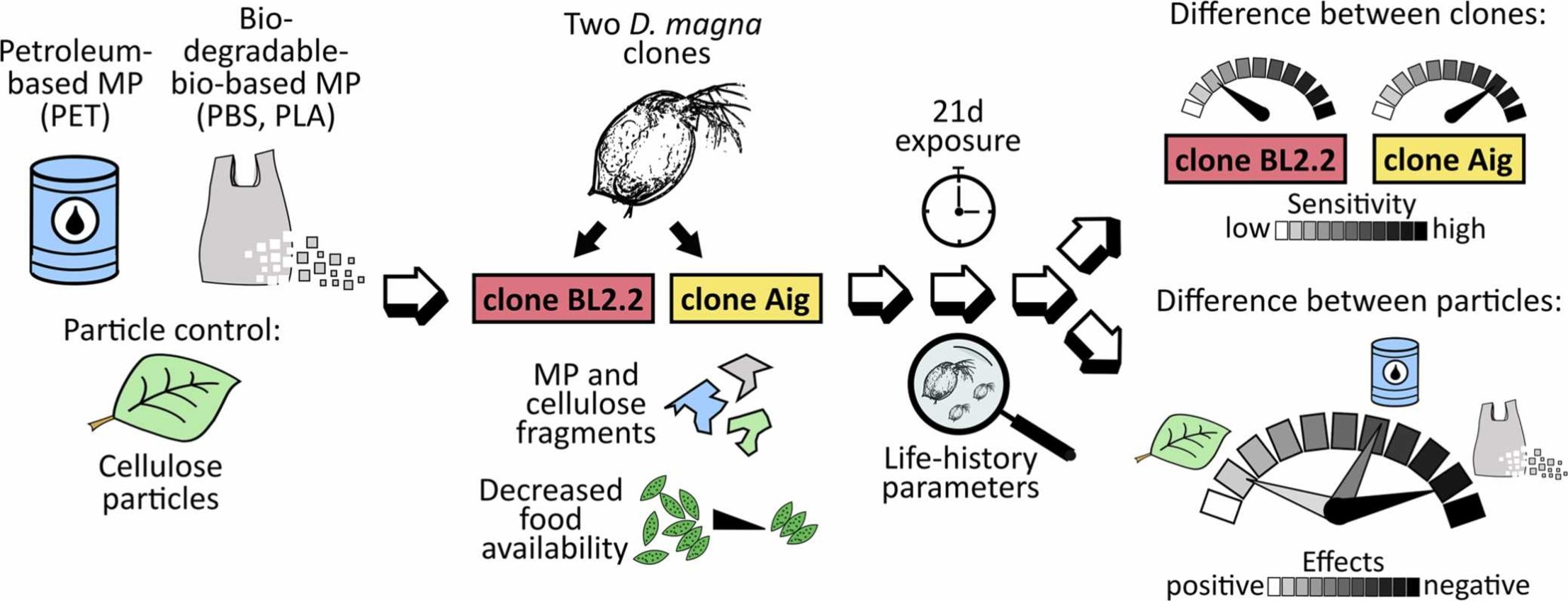

Microplastics (MP) derived from commodity plastics are considered a threat to ecosystems. Bio-based and biodegradable (BB-) plastics are proposed as eco-friendly alternatives to petroleum-based (PB-) plastics. However, studies on the effects of MP on the model organism Daphnia magna often report a wide range of effects for both PB- and BB-plastics. While different physical and chemical MP properties may contribute, other factors, such as differences in clonal sensitivities, are rarely considered. Additionally, only a few studies included a particle control to differentiate between effects caused by particles themselves and those specifically by MP. In this study, these knowledge gaps are addressed by (1) comparing the effects of PB-MP (PET) and two BB-MP (PBS, PLA) on the life-history and morphology of D. magna, and (2) examining the responses of two D. magna clones to chronic MP exposure (all MP < 20 µm), always including cellulose as a particle control, in a setup with reduced food availability to mimic real environmental scenarios. When comparing PB- to BB-MP, the latter caused similar adverse effects on survival and sublethal life-history traits, while cellulose had no effect or positive effects. We observed a similar concentration-dependent increase in mortality for both clones while data on sublethal parameters were significantly different between the clones. We conclude that particle controls and genetic variability are crucial parameters that should be considered in D. magna experiments and that MP effects need to be investigated under environmentally relevant conditions.