

News
Boosting Photocatalytic H2O2 Production via the Synergy of Protonation and Heterojunction in Covalent Organic Frameworks
18.02.2026
Yingwei Gao, Bo Ge, Hui Zhao, Chuanyu Jin, Seema Agarwal and Limin Zhao
Langmuir, 2026, https://doi.org/10.1021/acs.langmuir.5c06100
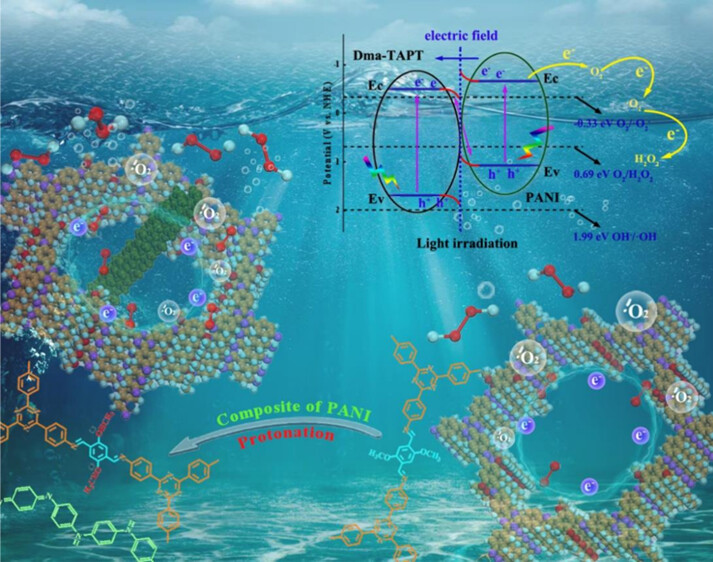

With high specific surface area, tunable framework structures, and outstanding chemical stability, covalent organic frameworks (COFs) can serve as photocatalysts to convert water into H2O2 under light irradiation. However, their low electronic transfer rates and narrow optical response range significantly constrain the application of COFs in photocatalysis research. Herein, a compound with an S-scheme heterojunction structure was synthesized by combining Dma-TAPT COFs with polyaniline (PANI) via a solvothermal method. Furthermore, protonated COFs were used to broaden the light absorption range and enhance charge transport. Owing to the synergistic effect, the photocatalytic H2O2 production of PANI-Dma-TAPT after protonation increased by 2.58 times (relative to Dma-TAPT). Under acidic conditions (pH 1), the H2O2 yield of H-PANI-Dma-TAPT reached 1171.7 μmol·g–1, which was 3.7 times higher than that of Dma-TAPT. This study offers both practical insights and theoretical understanding into photocatalytic H2O2 production.