

News
Mobility and retention of microplastic fibers and irregular plastic fragments in fluvial systems an experimental flume study
26.12.2025
Marco La Capra, Daniel Wagner, Seema Agarwal, Jan H. Fleckenstein, Sven Frei
Microplastics and Nanoplastics, 2025, https://doi.org/10.1186/s43591-025-00165-2
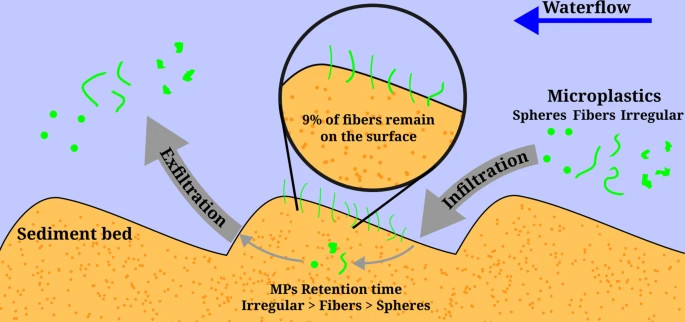

Pore-scale microplastics (< 10 μm) are emerging contaminants whose behavior and fate in aquatic environments remain poorly understood. While the transport and retention of spherical microplastics (SMPs) have been studied in fluvial systems, irregularly shaped microplastics (IMPs) and microplastic fibers (MPFs) remain poorly understood. This study investigates how IMPs and MPFs differ from SMPs in their transport and retention in open stream and hyporheic flows under controlled flume conditions using fluorescently labeled particles. We compared the transport dynamics of IMPs (d90 = 7.68 μm) and MPFs (diameter 5–10 μm, length 60–250 μm) with reference SMPs (1, 3, and 10 μm in diameter) by continuously monitoring microplastic concentrations in surface water and streambed sediments. IMPs exhibited mobility similar to SMPs, with minor retention in the system. In contrast, MPFs showed markedly higher retention, preferentially accumulating at the sediment–water interface, where ~ 9% of the introduced mass was retained. These findings demonstrate that particle shape and aspect ratio strongly influence microplastic transport and retention in fluvial systems, with implications for their ecological impacts and long-term fate.